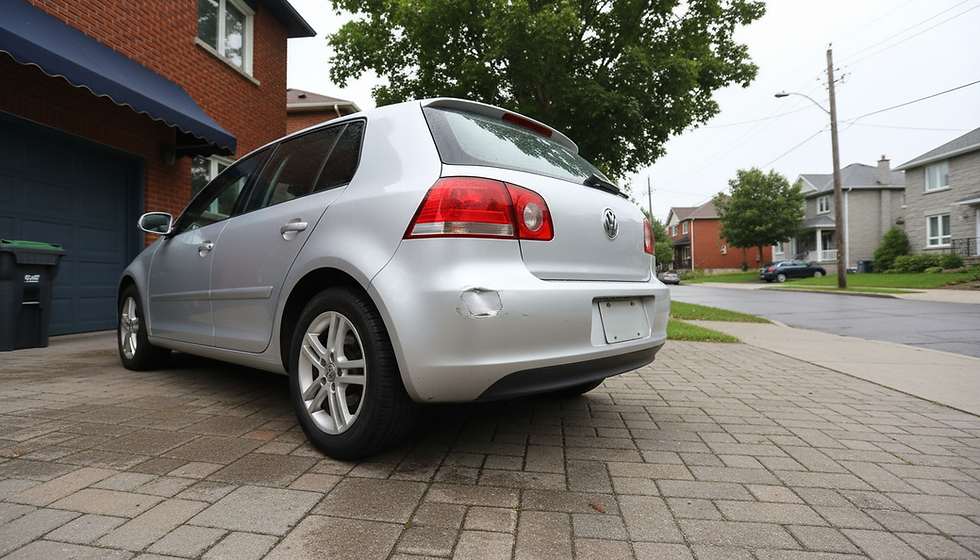
How to Spot Hidden Damage After a Minor Rear-End Collision

A minor rear end collision can be surprisingly deceptive. You step out of your vehicle, walk around to the back, and breathe a small sigh of relief. The bumper has a scratch, maybe a small dent, but everything else seems fine. The trunk still closes, the taillights are intact, and the car appears perfectly driveable.
So, no big deal... right?
Not necessarily.
Modern vehicles are designed to absorb and manage impact energy, which is excellent for occupant safety. However, that also means some of the components doing the hard work during a collision are hidden behind the bumper cover. A flexible plastic bumper may spring back close to its original shape while brackets, impact absorbers, sensors, reinforcement components, or other parts underneath have been damaged.
That is why even a seemingly minor rear-end accident deserves a closer look.
Hidden collision damage does not automatically mean your vehicle has a serious problem. In many cases, the repairs are straightforward. The important thing is identifying damage early rather than discovering it weeks later when a bumper becomes loose, a parking sensor stops working, the trunk begins leaking, or unusual tire wear appears.
For Montréal drivers, there is another reason to pay attention. Winter salt, moisture, potholes, freezing temperatures, and repeated freeze-thaw cycles can make existing damage worse over time. A small crack, exposed metal, or broken mounting point may become more problematic after a season of Québec driving.
In this guide, we'll explain how to spot hidden damage after a rear end collision, which warning signs deserve attention, what professional collision technicians inspect, and why a proper assessment can help protect your vehicle's safety, appearance, and long-term value.
1. Why a Minor Rear End Collision Can Cause More Damage Than You See
The first thing to understand about collision damage is simple: what you see from the outside is only part of the story.
A modern rear bumper is an assembly of multiple components rather than one solid piece. The painted bumper cover is largely cosmetic, while other components behind it help with mounting, impact management, electronics, and vehicle safety.
A relatively low-speed impact can therefore affect parts you cannot see without closer inspection or partial disassembly.
The Bumper Can Look Fine While Components Behind It Are Damaged
One of the most misleading things about a minor rear end collision is the flexibility of modern bumper covers.
Many are made from plastic materials capable of bending during a low-speed impact. After the collision, the cover can partially return to its original shape.
From a few feet away, it might look almost untouched.
Behind that cover, however, there may be several components that reacted differently to the impact.
Depending on the vehicle, the rear bumper assembly may include:
bumper reinforcement;
energy-absorbing material;
mounting brackets;
plastic retainers and clips;
wiring;
parking sensors;
blind-spot monitoring components;
rear cross-traffic sensors;
other driver-assistance equipment.
A flexible bumper cover returning to shape does not automatically mean all these components are undamaged.
For example, a mounting bracket can crack while the exterior surface remains intact. The bumper may then gradually become loose or develop uneven gaps around the quarter panels.
An energy absorber may also become compressed or damaged during the impact. Because it is hidden, a driver would have no obvious way of seeing the problem during a quick roadside inspection.
This is why professional collision assessment goes beyond asking, "Is the bumper scratched?"
Technicians look at how the entire assembly reacted to the impact.
Watch for visible clues such as a bumper that:
sits lower on one side;
has uneven gaps;
moves more than expected when gently pressed;
appears pushed inward;
has popped away from an adjacent body panel;
makes rattling sounds while driving.
Even small changes in alignment can indicate that clips, retainers, or mounting points need attention.
Hidden Damage After a Rear End Collision Can Affect the Trunk or Liftgate
The trunk or liftgate is another area worth checking carefully after being hit from behind.
Open and close it several times.
It should operate just as it did before the accident.
Pay attention if:
it requires extra force to close;
it no longer opens smoothly;
the latch does not engage correctly;
the gaps around the trunk lid appear uneven;
the power liftgate hesitates or behaves differently;
you hear rubbing or scraping;
the trunk warning light remains on.
These symptoms may indicate that something has shifted.
The issue does not necessarily mean severe structural damage. A latch, striker, hinge, seal, trim piece, or surrounding panel may simply need adjustment or repair.
However, the problem deserves inspection.
The trunk area also needs to remain properly sealed against water.
After the collision, inspect the weatherstripping around the trunk or hatch. Look for areas where the seal appears pinched, loose, torn, or uneven.
After rain or a car wash, check inside for:
damp carpet;
water near the spare tire compartment;
condensation;
a musty smell;
visible moisture around interior trim.
Water intrusion can become a much larger headache if ignored. Moisture trapped inside a vehicle can contribute to odours, corrosion, mould, and electrical problems.
A small alignment issue that seems cosmetic today can therefore become a more expensive problem later.
Look Beyond the Bumper for Quarter-Panel and Floor Damage
Rear impacts do not always stop at the bumper.
Collision energy travels through the vehicle, and depending on the speed, angle, vehicle design, and point of impact, surrounding areas may also be affected.
Inspect the rear quarter panels on both sides.
Look closely at the gaps where the bumper meets the body. Compare the left side with the right.
Potential warning signs include:
new creases;
unusual panel gaps;
chipped paint along seams;
panels that no longer sit flush;
trim that has popped out;
changes around the taillights.
Open the trunk and inspect the cargo floor as well.
If accessible, look beneath the carpet or removable cargo panels.
You are not expected to perform a professional structural inspection yourself, but obvious changes are worth noting.
For example, if the spare tire well appears distorted or interior trim no longer fits correctly after the accident, mention it when obtaining a repair estimate.
The important principle is that collision damage should be evaluated as a system.
The most visible scratch may not necessarily be the most important part of the repair.

2. Mechanical and Driving Changes After a Rear End Collision
Your vehicle can tell you quite a lot after an accident—if you pay attention.
Changes in how it drives, sounds, brakes, or handles may provide clues that the collision affected something beyond the bumper.
Do not deliberately conduct aggressive tests after an accident. Simply notice whether normal driving feels different.
Auto Body Inspection After a Rear End Collision: Watch How the Car Drives
After a minor collision, drivers naturally focus on the damaged bodywork. But vehicle behaviour can also provide useful information.
Does the steering wheel feel centred?
Does the vehicle continue straight on a flat road without unusual pulling?
Do you notice new vibrations?
Does the rear of the vehicle feel unstable?
These symptoms can have many causes unrelated to the collision, so noticing one does not automatically prove accident damage. However, if a change begins immediately after the impact, it deserves investigation.
Wheel alignment can potentially be affected in certain collisions, especially when the impact involves a wheel, suspension area, or significant force.
A vehicle with alignment problems may:
pull to one side;
require constant steering correction;
show uneven tire wear;
feel less stable at highway speeds.
Suspension components should also be considered if the impact was substantial enough or occurred at an angle.
The safest approach is not to diagnose the problem from the driver's seat. Instead, document what changed and explain it clearly to the repair professional.
A statement such as "The vehicle started pulling slightly right after the collision" is much more useful than simply saying "Something feels weird."
New Noises Can Reveal Hidden Rear End Collision Damage
Cars make plenty of normal sounds, which is why a new noise after an accident is worth noticing.
Listen for:
rattling;
clicking;
scraping;
clunking;
vibration;
exhaust noises.
A rattle from the rear may be something as simple as a loose bumper bracket or trim component.
A metallic sound may involve a heat shield, exhaust component, or another part that shifted during the impact.
The exhaust system deserves particular attention after a rear collision because portions of it run beneath the rear of the vehicle.
Depending on the design and impact location, components such as the muffler, exhaust pipe, hangers, or heat shields may be affected.
Possible exhaust-related warning signs include:
a louder exhaust note;
rattling underneath the vehicle;
visible exhaust misalignment;
unusual vibration;
exhaust fumes where they were not noticeable before.
If you smell exhaust inside the passenger compartment, treat that seriously and have the vehicle inspected promptly.
Exhaust gases should remain outside the cabin.
Do not assume a new sound will simply disappear after a few days.
Even if the cause is minor, identifying it early prevents uncertainty and helps ensure nothing important has been overlooked.
Check the Tires and Suspension After the Impact
Tires may seem unrelated to a rear bumper collision, but the way the vehicle was hit matters.
If another vehicle struck your car off-centre, pushed it sideways, or contacted a rear wheel, suspension and alignment concerns become more relevant.
Start with a visual inspection.
Compare the rear wheels from both sides.
Look for:
unusual wheel position;
visible tire damage;
fresh marks on the wheel;
sidewall cuts;
new bulges;
rubbing.
Over the following weeks, keep an eye on tire wear.
If one rear tire suddenly begins wearing differently from the other, alignment should be checked.
Suspension damage can also produce symptoms such as:
clunking over bumps;
unusual bouncing;
a change in ride height;
instability;
vibration.
Again, none of these symptoms should be self-diagnosed as a particular broken component. Modern suspension systems are complex, and multiple issues can produce similar sensations.
Your job as the driver is simply to notice changes.
A qualified technician can handle the diagnosis.
3. Electronic and Safety-System Damage You May Not Notice Immediately
Cars have changed dramatically.
Twenty years ago, a rear bumper was primarily a bumper. Today, that same area may contain sensors, wiring, cameras, radar equipment, and technology connected to advanced driver-assistance systems.
This makes modern collision repair more sophisticated—and makes hidden electronic damage increasingly important after a rear impact.
Parking Sensors Can Be Affected by a Rear End Collision
Parking sensors are commonly mounted directly in the rear bumper.
These small sensors help estimate the distance between your vehicle and nearby obstacles.
During a rear end collision, a sensor may be:
physically damaged;
pushed inward;
knocked out of alignment;
disconnected;
damaged at its mounting bracket;
affected by wiring damage.
Sometimes the failure is obvious. You put the vehicle in reverse and receive a warning message.
Other times, the system continues operating but behaves strangely.
Watch for:
continuous beeping;
no warning when approaching an obstacle;
false alerts;
one sensor responding differently from the others;
dashboard messages related to parking assistance.
Do not rely on a questionable parking sensor until it has been checked.
Use mirrors, cameras, and direct observation as you normally should.
The repair process may involve inspecting the sensor, mounting position, wiring, and diagnostic trouble codes.
If a component has been replaced or repositioned, manufacturer-specific procedures may apply.
Blind-Spot Monitoring and Rear Cross-Traffic Systems
Many modern vehicles contain driver-assistance technology near the rear corners.
Blind-spot monitoring can alert the driver when another vehicle is travelling in an adjacent lane. Rear cross-traffic alert can help detect approaching vehicles while reversing from a parking space.
These systems may rely on radar sensors located behind the bumper.
That creates an interesting situation after a collision: the exterior bumper may look relatively normal, but the technology behind it may require attention.
A sensor does not necessarily need to be shattered to experience a problem. Its mounting position matters.
If the sensor is moved or its bracket is damaged, system performance can potentially be affected.
Watch your dashboard for warnings after a collision.
If a blind-spot or cross-traffic system becomes unavailable, inconsistent, or behaves differently, mention this during the repair assessment.
Depending on the vehicle and repair, technicians may need to:
scan for diagnostic trouble codes;
inspect sensor mounts;
repair wiring;
replace damaged components;
perform required calibration procedures.
This is one reason a professional collision repair process should account for the technology installed on the specific vehicle.
Two bumpers that look almost identical from the outside can contain very different equipment underneath.
Rear Cameras, Wiring, and Lighting Problems
The rear of your vehicle contains plenty of electrical components beyond parking sensors.
Depending on the model, you may have:
backup cameras;
taillights;
brake lights;
license plate lights;
trunk-release switches;
power liftgate components;
proximity sensors;
wiring harnesses.
After the accident, test the basic functions you can safely check.
Have someone confirm that:
brake lights illuminate;
turn signals work;
reverse lights function.
Check your rearview camera display while parked safely.
The image should appear as expected.
If the camera is mounted on the trunk or liftgate, an alignment change could potentially alter its view.
A camera image that suddenly appears tilted or significantly different deserves attention.
Electrical issues can sometimes appear intermittently.
A damaged connector may work at first and fail later due to vibration, moisture, or corrosion.
This is especially relevant in Montréal winters, where moisture and road salt can be unforgiving to compromised electrical connections.
If warning lights appear after the collision, do not automatically clear or ignore them.
Diagnostic scanning can help determine whether the vehicle recorded faults related to the accident.

4. What to Do After a Minor Rear End Collision
Once you understand that hidden damage is possible, the next question is practical: what should you actually do?
You do not need to panic or assume the worst.
Instead, approach the situation methodically.
Document the accident, perform a basic visual and functional check, and arrange professional assessment when appropriate.
Document the Rear End Collision Before Damage Changes
Immediately after an accident, prioritize safety.
Move to a safe location when appropriate and follow applicable procedures for exchanging information and reporting the incident.
Once it is safe to do so, take photographs.
Capture:
the rear of your vehicle;
close-ups of visible damage;
both rear corners;
bumper alignment;
the other vehicle involved;
the overall accident scene;
license plates where appropriate;
road or parking conditions.
Take more photos than you think you need.
Different angles can reveal damage that is difficult to see in one image.
Also write down what happened while the details are fresh.
Note:
where the impact occurred;
whether you were stopped or moving;
which part of the vehicle was hit;
whether the car moved forward or sideways;
any new warning lights;
any sounds or driving changes afterward.
This information can be useful when explaining the accident to a repair shop or insurer.
Do not start pulling on damaged panels, forcing the bumper back into position, or removing parts unless necessary for immediate safety.
Changing the damage before it is documented can make assessment more difficult.
When a Rear End Collision Should Be Professionally Inspected
Not every tiny bumper tap will result in hidden damage, but there are situations where a professional inspection is particularly sensible.
Arrange an assessment if you notice:
a cracked or displaced bumper;
uneven panel gaps;
trunk or hatch problems;
warning lights;
parking sensor issues;
unusual noises;
exhaust changes;
water leaks;
steering or handling changes;
tire or wheel damage;
broken lights;
visible damage extending beyond the bumper.
You should also consider an inspection when the impact was strong enough to move the vehicle noticeably, even if the bumper cover looks surprisingly good.
Collision professionals understand how to look beyond surface damage.
Depending on what they find, the assessment may involve removing or loosening certain components to inspect concealed areas.
They may also use diagnostic equipment to check electronic systems.
A thorough estimate should identify what needs repair, what needs replacement, and whether additional procedures such as calibration are required.
Ask questions.
Useful questions include:
Is the damage only cosmetic?
Did you find anything behind the bumper?
Are the bumper reinforcement and absorber intact?
Do the sensors require testing?
Is any calibration required?
Is the trunk area properly aligned and sealed?
Are there signs of structural damage?
Can the bumper be repaired, or should it be replaced?
A good repair facility should be able to explain the findings in understandable language.
Why Fixing Hidden Damage Early Can Save Trouble Later
It is tempting to postpone repairs after a small collision, particularly when the vehicle still drives normally.
But some problems become more complicated with time.
A loose bumper mount can worsen with vibration.
A paint crack can allow moisture to reach vulnerable material.
Exposed metal can begin corroding.
A damaged trunk seal can allow water inside.
Compromised electrical connectors can become more problematic after exposure to moisture and road salt.
A misaligned component may cause rubbing or premature wear.
Addressing damage promptly helps prevent these secondary problems.
There is also the question of resale value.
When you eventually sell or trade the vehicle, unrepaired collision damage can affect buyer confidence and vehicle value.
A properly completed repair helps restore:
appearance;
fit and alignment;
function;
protection against corrosion;
operation of affected technology.
The objective should not be simply to make the scratch disappear.
A quality repair addresses everything the collision affected.
Conclusion: A Small Rear End Collision Still Deserves a Closer Look
A minor rear end collision can look harmless from the outside, but modern vehicles contain far more behind the bumper than most drivers realize. Mounting brackets, impact-management components, sensors, wiring, cameras, exhaust parts, trunk seals, and driver-assistance technology can all be affected without producing dramatic exterior damage.
That does not mean every bumper tap is hiding an expensive repair. It simply means the visible damage should not be the only thing considered.
After an accident, take a few minutes to document what happened, inspect the bumper and surrounding panels, test the trunk and lights, pay attention to sensors and dashboard warnings, and notice any changes in how the vehicle drives or sounds.
If something seems different—or if you simply want to know exactly what the impact affected—a professional collision assessment can provide clarity.
For Montréal drivers, Park Lane Collision is a trusted local auto body shop that can inspect damage after a rear-end accident and determine what actually needs attention, from bumper and paint repairs to hidden components and collision-related bodywork. Getting the right information early makes it easier to choose the right repair and get back on the road with confidence.
Sometimes the smallest-looking bump deserves the closest look.