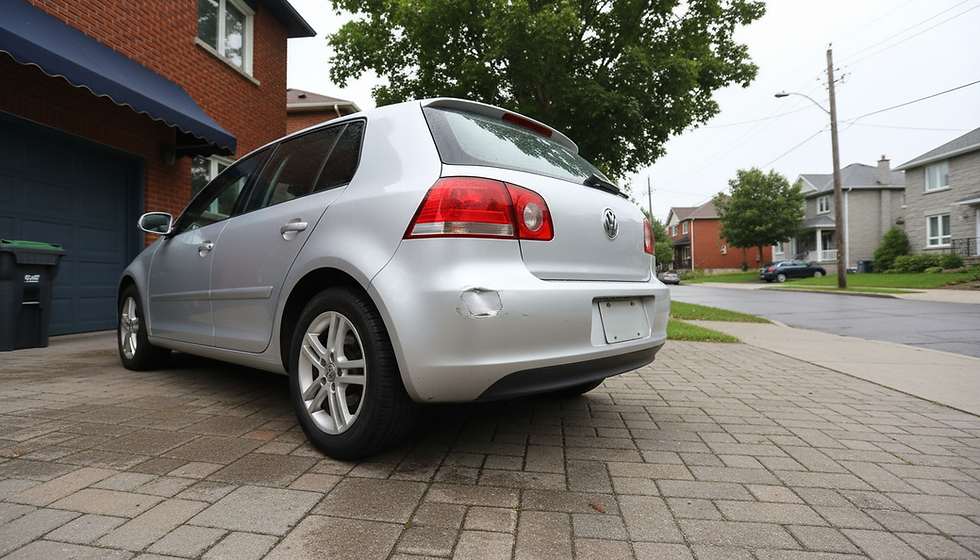
Parking Garage Damage: Common Auto Body Repairs After Tight Space Accidents

Parking garages are convenient, especially in a busy city like Montréal. They keep vehicles protected from snow, rain, and extreme weather, and they make downtown parking possible where street space is limited. Unfortunately, they also introduce a very different kind of driving challenge: tight corners, narrow parking spaces, concrete pillars, low walls, sharp ramps, and vehicles squeezing past each other with only inches to spare.
It only takes a small miscalculation to hear that sound every driver dreads—the scrape of a bumper against concrete, the crunch of a door meeting a pillar, or the bump that tells you the vehicle behind you was closer than your parking sensors suggested.
The good news is that most low-speed parking garage accidents are repairable. Modern auto body repairs can correct everything from minor scratches and dents to damaged bumpers, doors, mirrors, and body panels. In many situations, professional repairs can restore the vehicle so effectively that there is little or no visible evidence that the accident happened.
Still, parking garage damage should not automatically be dismissed as "just cosmetic." What looks like a small scrape may have damaged the clear coat and exposed the paint underneath. A bumper that looks slightly pushed in could have damaged mounting brackets or sensors behind it. Even a small door dent can affect paint integrity and eventually lead to corrosion.
For Montréal drivers, this matters even more because moisture, winter road salt, freeze-thaw cycles, and changing temperatures can turn neglected exterior damage into a larger problem.
So, what should you actually do after bumping, scraping, or denting your vehicle in a parking garage?
This guide explains the most common types of parking garage damage, the auto body repairs typically used to correct them, what may be hiding underneath apparently minor damage, and how to reduce the chances of another tight-space accident.
1. The Most Common Parking Garage Damage and Auto Body Repairs
Parking garage accidents tend to happen at relatively low speeds, but low speed does not necessarily mean no damage. Because garages contain concrete walls, columns, curbs, metal barriers, and other vehicles, even a slow impact can leave noticeable damage.
Understanding what happened—and what may need to be repaired—is the first step toward getting your vehicle back into shape.
Auto Body Repairs for Scratches, Scuffs, and Paint Transfer
One of the most common parking garage accidents involves scraping the side or corner of a vehicle against a concrete pillar or wall.
Sometimes the damage looks dramatic because concrete, paint, rubber, or another material transfers onto the vehicle's surface. In other cases, the contact actually cuts through the clear coat and paint.
These two situations can require very different repairs.
A superficial scuff may sometimes be corrected through professional cleaning, polishing, or paint correction. If the scratch has penetrated deeper layers, however, refinishing may be necessary.
Automotive paint typically consists of several layers, including primer, colour and a protective clear coat. Once a scratch penetrates these protective layers, the metal underneath can become more vulnerable to moisture and corrosion.
A professional repair process may include:
cleaning and evaluating the affected area;
removing transferred paint or surface contamination;
sanding damaged material;
filling deeper imperfections where necessary;
applying primer;
colour matching;
repainting;
applying clear coat;
polishing and blending the repaired area.
Modern colour-matching technology allows an experienced auto body shop to reproduce factory colours with impressive accuracy.
The original paint code is an important starting point, but technicians must also consider the current condition of the vehicle's finish. Sun exposure, age, previous repairs, and environmental conditions can slightly alter how a colour appears.
This is why professional blending can make such a difference.
A properly repaired scratch should not look like someone simply painted over a damaged area. The goal is to integrate the repair naturally with the surrounding finish.
And there is another reason not to ignore deep scratches in Montréal: corrosion.
A scratch that exposes bare metal may seem insignificant in August but become much more problematic after months of exposure to moisture and winter road salt.
Addressing the damage early can therefore protect both appearance and body integrity.
Dent Repair After Contact With Pillars, Walls, and Other Vehicles
Dents are another parking garage classic.
A door can strike a concrete pillar when opened. A front fender can clip a wall during a tight turn. Another driver can open a door into your vehicle. You may even return from shopping to discover a mystery dent that definitely was not there when you parked.
The repair method depends heavily on whether the paint has been damaged.
For certain shallow dents where the factory paint remains intact, paintless dent repair (PDR) may be an option.
Instead of filling and repainting the damaged panel, a technician carefully works the metal back toward its original shape using specialized tools and techniques.
When appropriate, PDR offers several advantages:
the original factory paint remains intact;
less refinishing work may be required;
repair time can be shorter;
the finished result can be extremely discreet.
However, paintless dent repair is not suitable for every dent.
If the metal is sharply creased, stretched, located in a difficult structural area, or accompanied by cracked paint, conventional body repair may be required.
Traditional dent repair can involve reshaping the panel, applying body filler where appropriate, sanding the surface, priming it, repainting it, and applying a new clear coat.
The important point is not to assume that every dent requires the same solution.
A professional assessment determines whether PDR, conventional repair, or panel replacement makes the most sense.
Bumper Auto Body Repairs After Low-Speed Impacts
Bumpers take a lot of punishment in parking garages.
Drivers reverse into walls, touch concrete columns while turning, misjudge another parked vehicle, or encounter curbs and barriers that sit below their normal line of sight.
Modern bumper covers are designed to tolerate some degree of impact, but they are not indestructible.
Common parking-related bumper damage includes:
scratches;
paint transfer;
dents;
cracks;
punctures;
broken clips;
damaged mounting points;
misalignment.
A lightly scratched bumper may only require refinishing. A dented plastic bumper may sometimes be reshaped. Cracks can occasionally be repaired depending on their location and severity.
More substantial damage can require replacement.
There is also an important distinction between the bumper cover you see and the components behind it.
Modern bumpers may contain or cover:
impact absorbers;
reinforcement structures;
parking sensors;
wiring;
blind-spot monitoring components;
radar or other driver-assistance equipment.
This means that an impact that leaves only modest exterior evidence can potentially affect more than the visible bumper surface.
If the bumper suddenly sits unevenly, parking sensors behave strangely, warning messages appear, or panel gaps have changed, a professional inspection becomes particularly important.

2. Hidden Damage: Why Small Parking Accidents Can Require Professional Auto Body Repairs
The frustrating thing about parking garage accidents is that their appearance does not always tell the whole story.
At low speeds, flexible plastic panels can temporarily deform during an impact and then return close to their original shape. The outside may therefore look relatively normal while clips, brackets, absorbers, sensors, or other components underneath have moved or broken.
That is why assessing the complete vehicle—not just the obvious scratch—is important.
Auto Body Repairs for Hidden Bumper and Mounting Damage
Imagine backing into a concrete wall at low speed.
You get out, look at the bumper, and see only a few scratches. You might reasonably assume the damage is cosmetic.
But the bumper cover is only one part of the system.
An impact can damage clips and mounting brackets without creating a dramatic crack in the bumper cover itself. If the mounting system is affected, you may notice:
a larger gap between the bumper and adjacent panel;
one corner sitting lower than the other;
movement when the bumper is gently pressed;
rattling while driving;
trim that no longer sits flush.
These signs should not be ignored.
A bumper that is no longer mounted correctly may become progressively looser with vibration and normal driving.
More importantly, components behind the cover should be inspected when the nature of the impact suggests that damage may extend beneath the surface.
Professional auto body repairs begin with diagnosis. Before deciding that a bumper simply needs paint, technicians need to determine whether the assembly itself remains properly attached and functional.
This prevents a cosmetic repair from covering a mechanical or structural problem.
Parking Sensors, Cameras, and Driver-Assistance Technology
Parking garages are precisely where drivers depend most heavily on cameras and sensors—and ironically, those are some of the components that can be affected during a parking accident.
Modern vehicles can include:
rearview cameras;
ultrasonic parking sensors;
front parking sensors;
blind-spot monitoring;
rear cross-traffic alert;
radar-based assistance systems;
automated parking technology.
A bumper impact can disturb sensors or their mounting positions.
Even if the sensor itself is not visibly broken, a change in position may affect its operation. Depending on the vehicle and repair performed, recalibration may be necessary.
After a parking impact, pay attention to changes such as:
constant warning tones;
sensors that no longer detect obstacles;
false warnings when nothing is nearby;
dashboard error messages;
camera images that appear misaligned;
driver-assistance warnings.
Do not simply assume that an electronic warning will disappear on its own.
The technology built into today's vehicles means collision repair is increasingly a combination of bodywork, electronics, diagnostics, and precise reassembly.
That is one reason professional assessment matters even after relatively minor impacts.
Door, Fender, and Panel Alignment Problems
Another common parking garage accident happens while turning around a pillar.
The front of the vehicle clears the obstacle, but the driver turns slightly too early and the side of the vehicle contacts the column.
Depending on the angle, the impact can affect more than one panel.
For example, damage may extend across:
the front fender;
front door;
rear door;
rocker panel;
wheel arch.
Look carefully at the gaps between panels.
Automotive body panels are installed with consistent spacing. If a door suddenly sits differently relative to a fender, or if it becomes harder to open and close, the impact may have moved something beyond the outer skin.
Signs worth checking include:
doors rubbing when opened;
unusually large or narrow panel gaps;
wind noise that did not exist before;
water entering around a door seal;
a hood, trunk, or hatch that no longer closes normally.
These symptoms require more than touch-up paint.
The body shop may need to inspect hinges, mounting points, latches, and adjacent panels to determine exactly what moved.
The objective of professional collision repair is not simply to make a vehicle look straight from ten feet away. Panels should fit, open, close, seal, and function correctly.
3. How Professional Auto Body Repairs Restore Parking Garage Damage
Once the damage has been assessed, the repair process can begin.
There is no universal repair procedure because a small door ding and a cracked bumper obviously require different approaches. A professional auto body shop selects the least invasive method capable of restoring the vehicle correctly.
Here are several of the techniques commonly involved.
Auto Body Repairs Using Paintless Dent Repair
Paintless dent repair can be an excellent option for certain parking garage dents.
The technique works particularly well when:
the dent is relatively shallow;
the paint has not cracked;
the metal is not severely stretched;
technicians can access the back of the damaged area or use appropriate alternative techniques.
Instead of repainting the panel, technicians manipulate the metal gradually until the surface returns as closely as possible to its original contour.
This requires considerable precision.
Vehicle panels contain curves, body lines, and varying levels of tension. Applying too much pressure in the wrong area can create high spots or make the damage more noticeable.
Professional PDR therefore relies on controlled movements and careful observation of how light reflects across the panel.
For drivers, the biggest advantage is preservation of the original finish.
If the factory paint remains intact, there is no need to introduce a new painted area unnecessarily.
This makes PDR particularly attractive for:
door dings;
minor parking dents;
certain fender dents;
some shallow impact marks.
However, the final decision should be made after inspecting the damage in person.
A dent that appears simple in a photograph may contain a crease or paint fracture that changes the appropriate repair strategy.
Paint Matching and Refinishing After Scrapes
When paint has been damaged, refinishing becomes an important part of the repair.
Today's vehicle colours can be surprisingly complex.
What appears to be simple white, black, grey, red, or blue may contain metallic flakes, pearl effects, multiple layers, or subtle variations that become obvious under different lighting.
Professional paint repair therefore involves much more than selecting a can with the correct colour name.
The process typically begins by identifying the manufacturer's paint code. Technicians can then prepare and adjust the colour as needed to match the vehicle's existing finish.
Depending on the location and size of the repair, blending into adjacent areas may be necessary to create a seamless visual transition.
Surface preparation is equally important.
If paint is applied over poorly prepared scratches, contamination, or damaged clear coat, the finished repair may not last or look correct.
Proper preparation can involve:
cleaning and degreasing;
sanding;
repairing imperfections;
priming;
applying base colour;
blending where necessary;
applying clear coat;
curing;
polishing and final inspection.
When performed correctly, the repaired area should integrate naturally with the rest of the vehicle.
This is particularly valuable after parking garage scrapes, which often leave long marks across highly visible doors, quarter panels, bumpers, or fenders.
When a Damaged Panel or Bumper Should Be Replaced
Repair is generally preferable when a component can be restored safely and effectively, but not every damaged part should be saved.
Replacement may make more sense when a panel or bumper is:
severely cracked;
torn;
extensively deformed;
damaged around important mounting points;
structurally compromised;
uneconomical to repair compared with replacement.
The decision is based on several factors, including damage severity, material, component location, repairability, safety considerations, parts availability, and cost.
For example, a small bumper crack may potentially be repairable, while extensive tearing around multiple mounting points may make replacement more practical.
Likewise, a heavily damaged door skin or fender may require a different approach than a shallow dent.
After replacement, the new component must still be properly fitted, aligned, prepared, and refinished.
On vehicles equipped with sensors or driver-assistance technology, additional procedures may also be necessary.
A good body shop should be able to explain why it recommends repair versus replacement.
As a vehicle owner, you should feel comfortable asking:
Can this component be repaired?
Why are you recommending replacement?
Does the damage affect anything behind the panel?
Will sensors or cameras need attention?
How will the paint be matched?
How long should the repair take?
Clear answers make the process much easier to understand.

4. What to Do After a Parking Garage Accident—and How to Avoid the Next One
You have just heard the scrape.
Now what?
A calm, methodical response can help you document what happened, identify potential problems, and avoid making the damage worse.
Once everything is handled, a few changes in parking habits can also reduce your chances of repeating the experience.
Before Scheduling Auto Body Repairs, Document the Damage
After any parking garage contact, stop the vehicle safely before inspecting it.
If another vehicle is involved, follow the appropriate procedures for exchanging information and documenting the incident.
Take clear photographs of:
the damaged area;
the entire side or end of the vehicle;
the surrounding parking area;
the obstacle or other vehicle involved;
any debris;
the position of the vehicles when appropriate.
Photographs can be helpful later if you need to explain the accident to a repair shop or insurer.
Next, inspect the vehicle carefully.
Check whether:
doors open and close normally;
the trunk or hatch works;
lights function;
mirrors remain secure;
the bumper is loose;
parking sensors operate correctly;
warning lights have appeared;
the vehicle makes unusual noises.
If something affects safe operation, do not continue driving simply because the exterior damage looks small.
Once the immediate situation is under control, arrange an estimate from a qualified auto body shop.
A professional estimate should consider both visible and potentially related damage rather than focusing exclusively on the most obvious scratch.
Why Delaying Small Auto Body Repairs Can Cost More
It is easy to postpone a parking garage repair.
The vehicle still drives. The scratch is only on one door. The dent is not very large. The bumper is still attached.
So why rush?
Because certain types of damage can deteriorate over time.
Deep paint damage is a good example.
The clear coat and paint help protect metal body panels from moisture and environmental exposure. Once those layers are compromised, corrosion becomes more likely.
Montréal's climate adds another challenge.
Vehicles routinely encounter:
rain;
snow;
ice;
road salt;
slush;
humidity;
repeated freeze-thaw cycles.
A small area of exposed metal can therefore face a difficult environment.
Corrosion that begins around a chip or scratch may eventually spread beneath surrounding paint, making a future repair more involved.
Loose bumper clips and damaged trim can also worsen with vibration, temperature changes, snow buildup, and regular use.
Addressing a straightforward repair early may therefore be simpler than waiting until secondary deterioration appears.
There is also resale value to consider.
When prospective buyers inspect a used vehicle, visible dents, mismatched panels, rust, cracked bumpers, and deep scratches immediately affect their impression of how the vehicle has been maintained.
Keeping the exterior in good condition can help preserve both appearance and long-term value.
How to Prevent Tight-Space Parking Damage
No driver is completely immune to parking accidents, but a few habits can dramatically reduce the risk.
First, slow down.
Parking garages are not the place to rush. At very low speeds, you have more time to evaluate distances and stop before contact occurs.
Pay particular attention to your rear wheels and the side of the vehicle when turning around concrete pillars. The front of the car may clear an obstacle while the middle or rear portion still follows a tighter path.
Use your mirrors rather than relying entirely on cameras.
Cameras are extremely useful, but they can distort distance or fail to show certain obstacles. Combine:
mirrors;
cameras;
parking sensors;
direct visual checks.
When a space feels too tight, there is no prize for completing the maneuver in one attempt.
Reverse, straighten the vehicle, and try again.
A few extra seconds are considerably less inconvenient than arranging body repairs.
Other useful habits include:
folding mirrors where appropriate in extremely narrow spaces;
avoiding spaces beside large vehicles when visibility is poor;
choosing an end space when available;
leaving enough room to open doors safely;
watching for low concrete walls that may not appear in mirrors;
paying attention to overhead clearance;
avoiding parking directly beside damaged or poorly parked vehicles;
checking your surroundings before backing out.
It can also help to learn the actual dimensions of your vehicle.
Drivers moving from a compact sedan to an SUV or pickup truck often underestimate the difference in width, wheelbase, turning radius, and front or rear overhang.
Give yourself time to become familiar with a new vehicle.
And remember: parking sensors are assistance systems, not substitutes for observation.
Snow, dirt, ice, moisture, damage, or sensor limitations can affect how accurately they detect obstacles.
Conclusion: Small Parking Accident, Proper Repair
Parking garage accidents are frustrating, but they are also extremely common. Narrow spaces, concrete columns, sharp corners, low walls, and limited visibility create plenty of opportunities for even careful drivers to misjudge a maneuver.
Fortunately, modern auto body repairs can address most of the damage these accidents create. Scratches can be refinished, appropriate dents may be corrected with paintless dent repair, damaged bumpers can be repaired or replaced, and professional paint matching can restore a clean, consistent finish.
The most important lesson is not to judge damage exclusively by how minor it appears.
A small bumper impact can affect clips or sensors. A deep scratch can expose metal to corrosion. A door dent can involve alignment issues. Getting the vehicle properly inspected allows you to understand what actually needs attention instead of guessing.
If your vehicle has picked up an unwanted souvenir from a Montréal parking garage, Park Lane Collision can help assess the damage and determine the appropriate repair. As a local Montréal auto body shop, the focus is on restoring your vehicle properly—from minor parking scratches and dents to bumper and collision repairs—so you can get back on the road with a vehicle that looks and functions the way it should.
And next time that concrete pillar looks a little too close, there is nothing wrong with backing up and trying the parking maneuver again. Your bumper will thank you.